
10 Operational Inefficiencies AI Can Eliminate Today
For small and medium-sized businesses, every hour counts. Your team is probably wearing multiple hats, and manual coordination is eating into time you should spend growing the business. From manual data entry to customer support, AI is helping SMBs reclaim hours each week — without massive budgets or complex setup.
The Impact in Numbers
20–40 hours/week saved on manual data entry
18-20 hours/week recovered from coordination overhead
60–80% reduction in error rates for manual processes
$24,000–$50,000+ annual savings for most SMBs
ROI within 4.2 months on average
Who This Applies To
Whether you're running a service business, a small agency, an e-commerce shop, or a consulting firm with a lean team, these inefficiencies probably apply to you. If your team is juggling multiple tools (Asana, email, spreadsheets, Slack) and spending time on coordination instead of client work, read on.
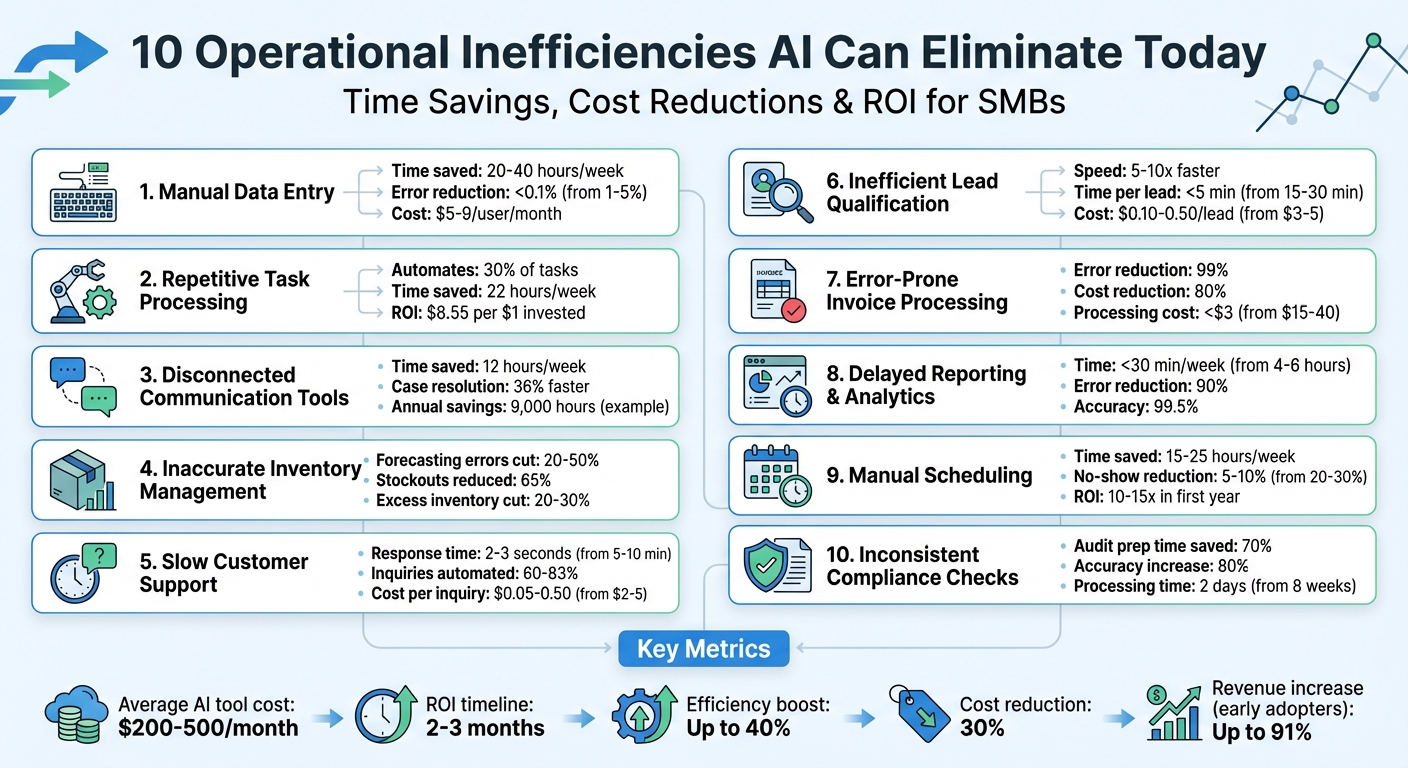
10 AI Solutions That Eliminate Operational Inefficiencies: Time and Cost Savings
1. Manual Data Entry
The Problem: Your team spends 20–40 hours per week typing information from one tool into another. Vendor details from invoices into QuickBooks. Form responses into your CRM. Customer data across spreadsheets.
The Solution: AI tools using OCR and automation extract data from documents and sync it across systems automatically. Instead of 10 minutes per form, it's 10 seconds.
The Impact: A 5-person team losing 6 hours weekly to data entry = $15,600 annually in wasted labor. Automation cuts that to near zero while reducing errors from 1-5% to less than 0.1%.
2. Repetitive Task Processing
The Problem: Your team spends hours on tasks like email sorting, meeting summaries, invoice generation, and spreadsheet updates. These tasks repeat daily across multiple team members.
The Solution: Workflow automation handles multi-step processes across tools. Sort emails → draft response → log in CRM → send follow-up. All automated.
The Impact: 22 hours/week saved per person. At $50/hour fully loaded, that's $57,200 annually for a 5-person team. Automation typically costs $200–$500/month.
3. Disconnected Communication Tools
The Problem: Information lives in Slack, email, Asana, spreadsheets, and your CRM. Your team spends 12 hours per week searching for information, asking "did anyone update this?"
The Solution: Unified dashboards and automated syncing pull data from all your tools into one view. One source of truth instead of five.
The Impact: Over 90 minutes per week per user reclaimed. Teams stay in sync without manual updates. No more duplicate work or missed context.
4. Inaccurate Inventory Management
The Problem: Spreadsheet-based inventory goes out of date within hours. Stockouts lose sales. Overstocking ties up cash.
The Solution: Automated systems track inventory in real-time and trigger reorders when levels drop below thresholds.
The Impact: Improved availability (70% → 94% in real cases). Reduced stockouts by 65%. For a retail or e-commerce business, this directly increases revenue and frees up cash.
5. Slow Customer Support Responses
The Problem: Your support team takes 5–10 minutes to respond to routine questions. 78% of customers choose the company that responds first.
The Solution: AI chatbots handle 60–80% of support inquiries instantly (24/7). Complex issues route to humans who provide real value.
The Impact: Response times drop from minutes to seconds. Support team size doesn't need to grow as volume increases. Cost per inquiry drops 80%+ while satisfaction increases.
6. Inefficient Lead Qualification
The Problem: 67% of your sales team's time is wasted on leads that never convert. Manual research on every prospect takes 15–30 minutes per lead.
The Solution: AI analyzes leads instantly, scoring them by fit and likelihood to convert. Sales team focuses only on qualified opportunities.
The Impact: Qualification time drops from 30 minutes to <5 minutes per lead. Conversion accuracy improves 40–60%. Sales team closes more deals without expanding headcount.
7. Error-Prone Invoice Processing
The Problem: Manual invoice entry has a 1–3% error rate. Fixing one error costs $50–$500 in labor and late payment penalties.
The Solution: AI processes invoices with 99%+ accuracy. Three-way matching (invoice vs. PO vs. receipt) catches discrepancies automatically.
The Impact: Processing time drops from 10 minutes to 30 seconds per invoice. Errors nearly eliminated. For a company processing 300 invoices/month, that's $3,600–$11,100 in annual savings plus faster cash flow.
8. Delayed Reporting and Analytics
The Problem: Generating weekly or monthly reports takes 4–6 hours and requires manual data consolidation from multiple systems.
The Solution: Automated dashboards pull data in real-time. Reports generate automatically and update continuously.
The Impact: 4–6 hours per week → 30 minutes. Leadership sees accurate data in real-time instead of waiting for reports. Better decisions happen faster.
9. Manual Scheduling and Appointments
The Problem: Confirming appointments, sending reminders, and rescheduling takes 15–25 hours per week. No-show rates hit 20–30%.
The Solution: Automated scheduling lets customers book directly. Automated reminders (SMS/email) reduce no-shows to 5–10%.
The Impact: Administrative time cut by 80%. Consistent revenue (fewer empty slots). Customer experience improves (they get instant confirmation).
10. Inconsistent Compliance and Audits
The Problem: Manual compliance checks mean issues slip through. When audits happen, your team scrambles to gather evidence.
The Solution: Continuous monitoring collects audit evidence automatically. No scrambling. No surprises.
The Impact: Audit preparation time drops 70%. Compliance risk decreases. Your team focuses on growth instead of firefighting.
When DIY Tools Aren't Enough
You might be thinking: "Can't we just use Zapier or Make to automate this?"
For simple, one-off tasks — absolutely. A Zapier integration that syncs your form responses to your CRM costs $20/month and saves hours.
But when you need to automate across multiple tools, handle complex logic, or integrate custom databases, off-the-shelf tools hit their limits. That's when custom automation starts making sense — whether you build it internally or work with an agency.
See how it works in practice: Echo Analytics unified 2,700 sales opportunities and 1.2M data points across HubSpot, Salesforce, and Gong into a conversational intelligence layer. What used to take hours of manual analysis now takes seconds. → Read the Case Study
The good news? The ROI is usually clear. If automation saves your team 10 hours per week at $50/hour fully loaded, that's $26K annually. A custom workflow typically costs $3K–$10K to build. You're profitable in months.
Which of These Hit Home?
Before you automate, it helps to know exactly which processes are costing you the most time and money. Our free Process Audit Checklist walks you through identifying your highest-impact automation opportunities.
Takes 5 minutes. Shows you where to start.
The Bottom Line
Operational inefficiencies don't need to be permanent. The businesses winning right now are the ones automating early — and they're not waiting for a huge IT budget or a big team overhaul.
Most of the inefficiencies above can be addressed in weeks, not months. Start with the highest-friction task (the one eating the most time), automate that, and build from there.
Your team will thank you. They'll have more time for work that actually moves the needle.
Ready to Find Your Highest-Impact Automation?
Not sure where to start? Our 2-minute automation assessment helps you identify which inefficiencies would move the needle most for your business.
No credit card. No sales pitch. Just a quick roadmap for what to automate first.