
AI Dashboard for Business: Finding Hidden RevOps Insights
Your RevOps team is sitting on a goldmine of unleveraged client data across Hubspot, Gong and other tools such as notion, sheets and email.
Here's what's actually happening: 40% of revenue teams can't properly connect Gong and HubSpot due to API complexity and data structure mismatches. Your call intelligence lives in one system. Your deal data sits in another. Your financial records exist in a third.
The invisible friction between these disconnected systems buries critical patterns like product seasonality, competitive threats, and regional buying behaviors under hours of manual data export. Gong's native HubSpot sync only transfers surface-level activity data—not the contextual insights that explain why deals actually close or die.
When your geo-localization data products show different seasonal patterns across 12 countries and 8 industries, you can't spot these trends by manually cross-referencing spreadsheets. You need an AI dashboard for business that connects the dots between what prospects say on calls, how they behave in your CRM, and when they actually buy.
The companies winning in 2026 aren't collecting more data. They're building unified intelligence layers that turn fragmented information into revenue-generating action—automatically.
The Invisible Friction Between Gong and HubSpot
Gong's HubSpot integration logs data as activities rather than populating specific CRM fields, creating manual data entry burdens and poor CRM hygiene. It doesn't populate the specific CRM fields your RevOps team actually needs to analyze performance patterns.
Your call recordings contain rich context about deal velocity, competitive mentions, and buyer objections. But Gong's native integration treats this intelligence like simple calendar entries. Activity logged: "Call completed with prospect." The actual conversation insights remain trapped in Gong's separate system.
The real busywork starts when your RevOps team needs deeper analysis. Exporting Gong data to HubSpot can take up to six hours, with recommendations to limit to 50 fields per object to avoid performance issues. For HubSpot datasets exceeding 10,000 concurrent CRM updates, Gong data sync times can extend up to 2 hours. Changes to integration configurations can take 2-24 hours to become available.
Your team burns entire afternoons wrestling with API limitations and field mapping errors. Meanwhile, critical patterns hide in the gap between systems. Did that enterprise deal stall because of pricing objections mentioned on calls? You'll never know by looking at HubSpot's deal stage alone.
The breakthrough happens when you stop accepting these artificial boundaries. Cross-referencing call intelligence with CRM behavior and financial data reveals the actual drivers behind revenue performance. A prospect's tone shift during competitive discussions. Budget concerns expressed three calls before the deal officially stalled. Regional buying patterns that only emerge when conversation data meets pipeline analytics.
These insights don't exist in isolated systems. They emerge from the connections between them.
Surface-Level Data Cannot Answer Why: 5 Hidden Revenue Leaks
Your HubSpot dashboard shows declining performance. Your Gong summary reports completed calls. But neither system explains why revenue actually drops.
Revenue leak #1: A region's data quality issues silently driving churn. Financial reports confirm the losses. But call recordings reveal clients repeatedly mentioning "inaccurate demographic data" and "outdated location intelligence." The real issue isn't market saturation—it's systematic data decay in your European datasets.
Revenue leak #2: Competitors systematically targeting your strongest accounts. Lost deal reports show enterprise clients choosing alternatives. Competitive intelligence platforms flag increased rival activity. But only call recordings expose the pattern: prospects mention the same competitor presentations happening within 48 hours of your demos. They're not randomly losing deals—they're being outflanked.
Revenue leak #3: Long-term contracts stalling due to budget uncertainty. Pipeline reports show deals stuck in "proposal sent" for 90+ days. Financial projections indicate healthy margins. Call recordings reveal the truth: procurement teams cite "funding delays" and "budget freezes" across multiple enterprise prospects. The stall isn't about your pricing—it's about their internal financial planning.
Revenue leak #4: Clients churning over unmet data requirements. Usage analytics show declining API calls. CRM data confirms contract non-renewals. Call recordings capture the missing context: clients need real-time demographic updates, but your current data refresh cycle runs monthly. They're not leaving for better service—they're leaving for fresher data.
Revenue leak #5: Conversion rates plummeting in a key region. Revenue impact analysis confirms significant losses. Call recordings and system timelines reveal the root cause: regulatory compliance delays in your data processing pipeline specifically affect financial services clients.
As we explored in our analysis of marketing agencies' operational challenges, the solution isn't adding more monitoring tools. It's connecting existing data sources to surface patterns that individual systems can't reveal.
Spotting Seasonality With an AI Dashboard for Business
Echo Analytics, a Paris-based geo-localisation data company, faced a complex challenge: tracking seasonal buying patterns across multiple regions and industries. Their RevOps team couldn't manually correlate pipeline data while monitoring thousands of active opportunities.
Their solution: we built a unified revenue intelligence platform on PostgreSQL with AI semantic search, consolidating HubSpot, Gong, and Supabase. The platform indexed their complete library of sales calls alongside more than 1.2M data points unified from their systems.
The results: 90% time saved on analysis and a much faster drive from insight to revenue generating action. Instead of spending weeks exporting data between systems, their AI dashboard surfaced patterns automatically.
AI demand forecasting improves seasonal business accuracy by 20-50% compared to traditional methods. These insights remained invisible when data lived in disconnected systems. Call recordings mentioned "budget planning cycles" and "regulatory deadlines," but connecting those conversations to actual deal closure patterns required cross-referencing multiple platforms. Their AI dashboard automatically surfaced correlations between conversation topics, deal timing, and revenue outcomes.
Manual analysis couldn't scale across thousands of prospects discussing different seasonal needs. The AI layer identified micro-frictions in regional sales processes and connected prospect concerns expressed on calls to actual buying behaviors tracked in their CRM.
The Real Cost of Fragmented Intelligence
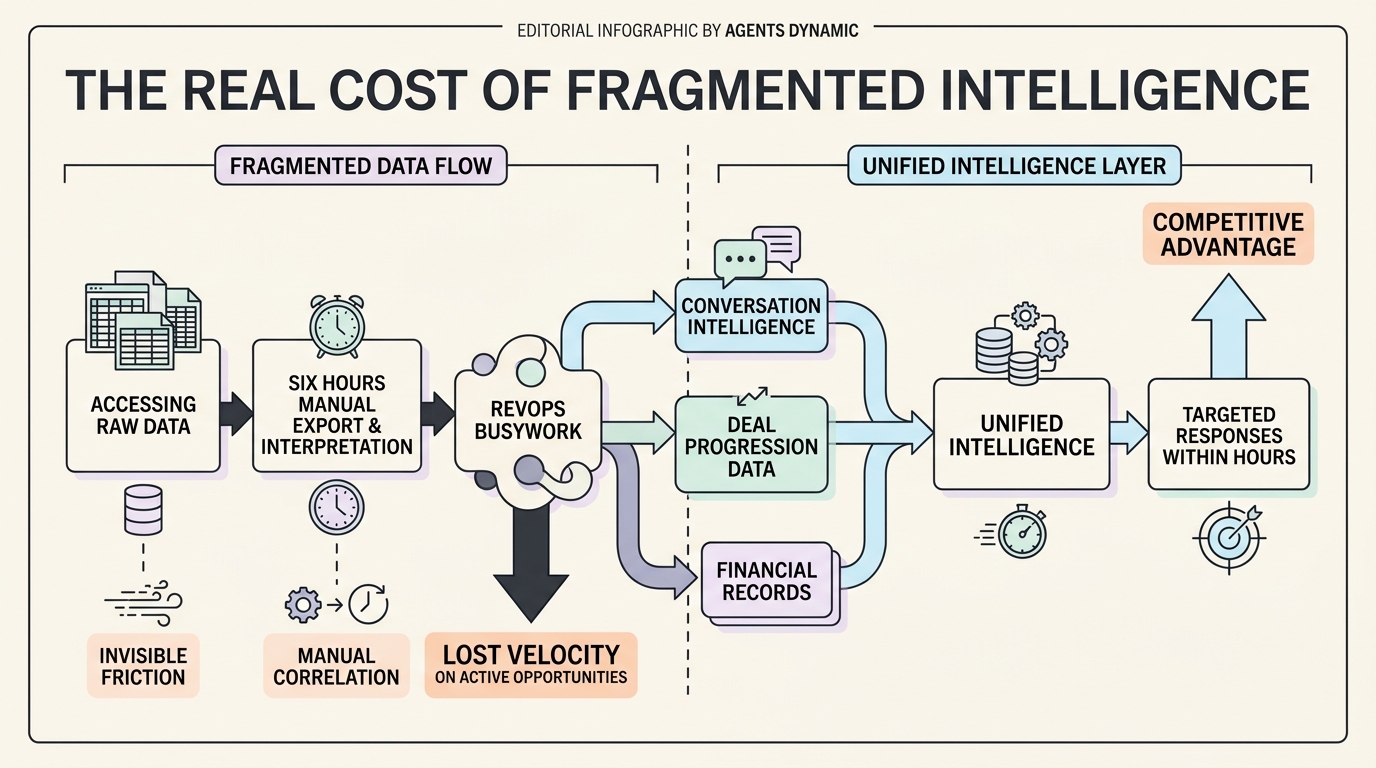
Raw data becomes worthless when accessing it requires six hours of manual export and interpretation. Your team already possesses the conversation intelligence, deal progression data, and financial records needed to predict revenue outcomes. The barrier isn't data availability—it's the invisible friction between disconnected systems that transforms actionable insights into busywork.
Every minute spent manually correlating Gong recordings with HubSpot deal stages represents lost velocity on active opportunities. While your RevOps team exports spreadsheets, competitors with unified intelligence layers identify prospect concerns and deploy targeted responses within hours of sales calls.
The companies pulling ahead aren't collecting more data points or adding new monitoring tools. They're eliminating the artificial boundaries between systems that already contain their revenue answers. When conversation intelligence flows directly into execution engines, insights become immediate action instead of delayed analysis.
Your next quarter's performance depends on how quickly you can connect what prospects say to ho
w you respond. Book a free 30-min consultation to see how Agents Dynamic can build a custom AI dashboard for business to turn your disconnected systems into a revenue engine.